MEMBER SPOTLIGHT Q&A: KARA ALARIC ON HONOURING NATIONAL DAY FOR TRUTH AND RECONCILIATION
Inspired by her Indigenous grandmother and childhood hairdresser in the Yukon, Kara Alaric discovered her love for hairstyling at a very young age. Today, Kara is an IATSE 891 Hair Department member, with credits to her name such as ‘Voicemails for Isabelle’, ‘Supernatural’, and ‘Midnight Sun’. In this Spotlight Q&A, she shares her journey from the small community of Teslin, Yukon, to Vancouver, British Columbia, and discusses the importance of Indigenous representation in film and television, as well as what National Day for Truth and Reconciliation means to her. We acknowledge that our work takes place on the unceded traditional homelands of the Coast Salish Peoples, on the homelands of the skwxwú7mesh (Squamish), selílwitulh (Tsleil-Waututh), and xwməθkwəýəm (Musqueam) Nations. This interview has been edited for clarity.
Kara, thank you for being here with us today. Can you tell us a bit about yourself, your background, and what inspired you to pursue a career in the motion picture industry?
I grew up in a very small community in the Yukon called Teslin, with a population of 500 people at the time. I lived there until I was about four years old, and then my family moved us to Whitehorse. I was very connected to my community, my family, and especially my Grandmother, rest in peace, who was Indigenous.
Growing up, most people would think I pass as white. I was “too white” for the Indigenous community and “too brown” for the white community. I’ve faced some things in my film career and heard some things I wish I never did.
I was always creative and a bit of an artist. Growing up in such a remote area, I didn’t think that the film industry was even an option for a career. When I moved away at 20 and ultimately came back to Canada, I thought to myself, “Okay… what can I do that’s creative and allows me to work with people?”
I decided to go to hair school! When I graduated, I immediately started working in salons. I thought that I was on my path. Then, one day, I got a phone call from a makeup artist friend. She said to me, “Hey, you do hair, right? You should come do this movie!”
I was only 23 or 24 years old at the time. I showed up to set with my suitcase of gear. When I got to the makeup and hair trailer, my friend told me, “By the way, you’re the department head.” I really got shoved in the deep end, but I haven’t stopped ever since. It has been a real blessing, and I love my job.
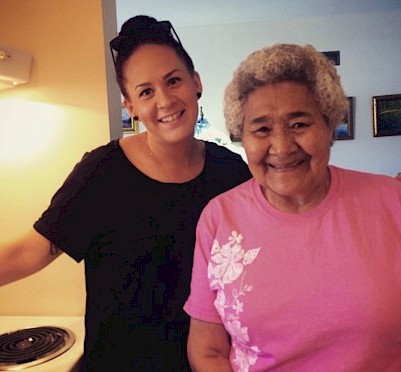
Kara and her grandmother in her grandmother's old apartment in Whitehorse, Yukon.
Growing up in a small town and having such a tight-knit community, were there any people, experiences, or creative influences in your life that inspired you?
When I was a teenager, there was a hairdresser in the Yukon that I would go to all the time. She is an Indigenous woman, and her name is Brandi Bailey. Sitting in her salon chair, watching this strong, gorgeous Indigenous woman create – it really inspired me. She made people feel good. Brandi had a huge impact on where I went with my career path. She changed my life!
After spending some time away in your 20s, what eventually brought you to Vancouver?
My Grandmother, my Indigenous matriarch, loved Vancouver. We would visit Vancouver a lot when I was younger. I remember walking along Robson Street together. To come away to the city and see a metropolis compared to the forest was special because it was different and exciting. She would always say, “One day, I’m going to live there.”
When I decided I wanted to go to hair school, I stumbled upon the Blanche Macdonald Centre, which is named after a Métis woman. That was a big draw for me, and everything just lined up beautifully and worked out the way it did.
To come to Vancouver for hair school, my path was definitely a little different and out of the ordinary for people back home. So, to have the support that I have, I’m very grateful.
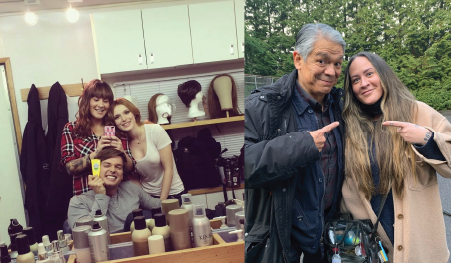
Kara with actors Patrick Schwarzenegger and Bella Thorne on 'Midnight Sun' (left) and Canadian actor/director Lorne Cardinal (right).
In what ways does your Indigenous heritage influence the way you approach your work as a hairstylist in the motion picture industry?
Hair is so tremendously sacred to Indigenous culture. Our hair is a direct passage from our minds and memories formed into a physical part of us. It is important for us to treat our hair with respect as it holds connection to our ancestors and to the Lingit’aani (earth). Many of us do not cut our hair unless there is a shift in life’s energies, or if family members pass away.
Sadly, one of the first transformations of colonization in Canada’s residential schools was to cut all the children’s hair off. You can get a feeling of how traumatic that would be to a child who was taught that their hair holds memories and connection to our earth and ancestors.
This is why I choose to wear my hair long today. To honour my lineage and the children who couldn’t keep their connection by wearing their hair long.
It is quite fitting that I am a member of the Hair Department! I have, over many years, been brought on to shows to work with our wonderful Indigenous film community of actors, background performers, and stunt people. It is always an honour when anyone from that community lets me touch their hair. Or sometimes even cut it! Lily Gladstone asked me to, in her words, “chop it off!” I didn’t chop it off. We settled on a nice healthy trim instead.
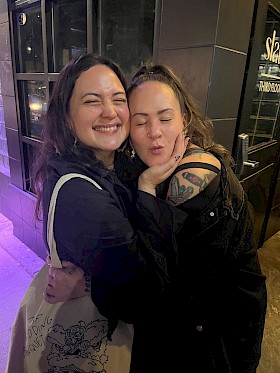
Kara and Native American actress and producer, Lily Gladstone.
What made you decide you want to be part of a unionized film community, and how has that experience been so far?
I’ve been fortunate enough to work on many different shows, both non-union and union. But I think the calibre and the pay involved is just a different experience when you’re on an IATSE production. The benefits are a huge perk, too.
But there’s more than that. There are training opportunities, further education, and community. The reason I work in the industry that I do is because there is an opportunity to learn something new every day. I love working with wigs, and I knew that being in IATSE would give me the opportunity to learn more about them. The Union offers courses on wigs, textured hair, curly hair… to have that is a big draw for me.
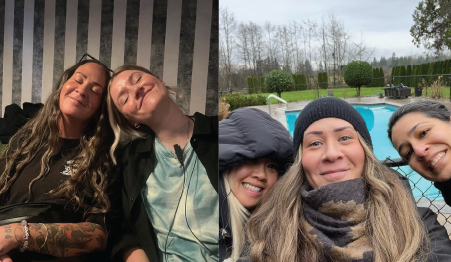
Kara and 891 makeup artist Karley Stroscher (left) and 891 hairstylists Chantima Phaengmany and Parisa Mamdooh (right).
Have you seen any changes in the industry in the way that Indigenous people and stories are represented?
For me, the biggest change would be having more Indigenous representation on camera, and not in the stereotypical way we’ve all been conditioned to think of. We’ve been forced into thinking that Indigenous people only wear their hair in two braids. Although braids are very important and scared to certain tribes, that isn’t the only way Indigenous people represent themselves. We are not just people sitting outside of a teepee with two braids.
Little kids can go home, turn on their television and think, “Oh wow, that person looks like me!” That’s very exciting, and it opens the doors to more opportunities. I think anyone in the BIPOC community can agree.
It’s also just as exciting to have more Indigenous representation behind the camera. It’s really fun to run into Indigenous crew on set! It doesn’t matter which part of North America you’re from, the humour within the Indigenous community is the same, and so is the slang.
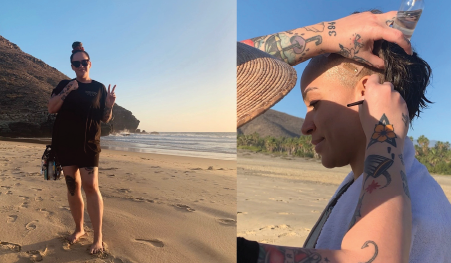
Kara on set for 'Balestra' and doing a wig removal on actor Cush Jumbo (right).
What does the National Day for Truth and Reconciliation mean to you personally?
I struggled for a while, and I still struggle when people refer to it as “Orange Shirt Day” because, to me, it is so much more than that. I see and understand the significance in Phyllis Webstad’s story, but National Day for Truth and Reconciliation is more than just wearing orange. Wearing orange is a start…but there’s more you can do to be an ally.
Now, when I think of this day, I feel empowered, and I think of my Granny. I think of how proud she would be if she was still here. I also have a sense of pride and importance. I feel like I have a job to share and to create safety for people who might be scared to come forward with their truth.
It’s still melancholy, but it’s important to remind myself that it’s a step, and steps will turn into strides.
What are some meaningful ways union members can honour National Day for Truth and Reconciliation?
Acknowledge the Indigenous people in their lives and take the time to listen. My Granny would always say, “I see you.” That means I love you; I’m here for you; I’m listening to you. It’s a huge sense of acknowledgement to just be seen.
Truthfully, you don’t always have to contribute – you just have to listen. Let the day be a day of listening and learning. There’s been a lot of suppression for a lot of years, and there are so many stories to be told. Not everyone is ready to come forward, but for the people that are, you save space for them and let them speak their truth. It’s the best thing you can do.
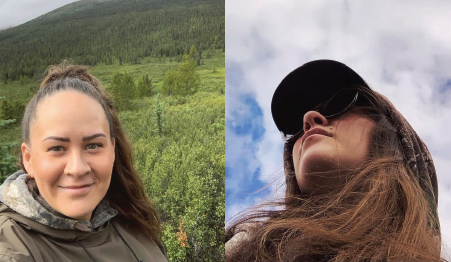
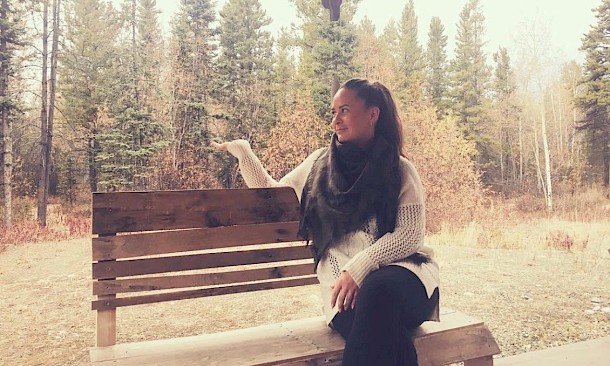
Photos of Kara in the Yukon.
Are there any Indigenous organizations, artists, creators, or businesses that you would encourage members to learn about and support?
Women Helping Women Beadwork is an organization that provides beading supplies to incarcerated Indigenous women. As a collective, their funds are used to support the women upon their release.
Red Rebel Armour is an Indigenous streetwear brand that is known for their powerful messaging. I always receive some form of acknowledgement when I wear their clothing on set. Sometimes a nod, or even a hug.
Decolonial Clothing is another Indigenous streetwear brand that I love. They collaborate with local organizations and schools to create pieces that encourage conversation about decolonization.
Colonialism Skateboards is a skateboard brand based in Regina, Saskatchewan. They collaborate with Indigenous artists to create their skate gear and apparel. My cousin from Teslin, Yukon, skates professionally for them!
Finally, what is one message you would like to leave with your fellow members of the BC film community as we mark National Day for Truth and Reconciliation?
Listening is the most important thing you can do. There are a lot of people who are still struggling due to generational trauma, processing grief that their ancestors couldn’t process. I think it’s wise not to press people with questions, but rather to listen and educate yourselves.
There are endless amounts of resources out there that can be accessed on so many platforms. I think it’s important to further our education and understanding of our fellow humans so that we can all show up for one another. My favourite way of learning is by picking up a book.
There are so many great Indigenous authors and resources on understanding the Indian Act. The mistreatment of Indigenous people is rooted in systemic racism. It is present within our day-to-day lives and many of us don’t even understand where the racism comes from – that’s why it is so important to keep learning, keep pushing forward, and keep understanding “why?”
A hard read but an important one is ’21 Things You May Not Know About the Indian Act’ by Bob Joseph. I have been reading this book for years because I have to take it in small doses. It is a lot of information to digest.
There are also many wonderful fiction books out there that can help you get a better understanding of our culture and humour. Though, sadly, our history isn’t a happy one, and so it is common for there to be a mention of the sufferings our people and communities have endured.
My message to my fellow 891 community is in my native language of Tlingit: “Gunalchéesh. Yak’ê ixhwsatìní. Yee gu.aax x’wán. Kei haa naltseen.” (Thank you. I am happy to see you. Have courage, all of you. We are becoming strong.)
Resources:
- IATSE 891 REDI Member Support Tools and Resources
- IATSE 891 REDI Updates, Sharing Info, Learning Opportunities, and more
- Hope for Wellness Helpline Website and Hotline 1-855-242-3310
- LinkedIn Learning Course on “Diversity, Inclusion, and Belonging for All”
- National Centre for Truth and Reconciliation
Interview and editing by IATSE 891 Copywriter Erica Lim.
Are you an Indigenous 891 member interested in being interviewed for a Member Spotlight? Email communications@iatse.com!
Learn more about working in the film industry in BC by checking out more 891 Member Spotlights here! Visit Ourwork.ca for more on the benefits of joining the Union.