MEMBER SPOTLIGHT: KIM GODDARD'S DAY IN THE LIFE IN THE PRODUCTION HIVE
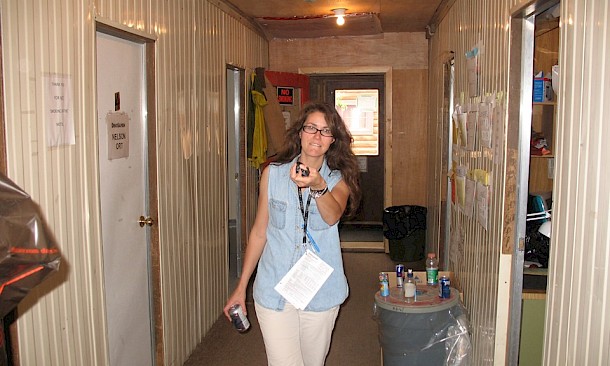
From publishing call sheets and coordinating shoot dates to receiving personal thank-you phone calls from Billy Bob Thornton, there is never a dull moment in the ‘hive’. Kim Goddard is a member and chairperson of the IATSE 891 Production Office Department, with credits to her name such as ‘Shōgun’, ‘Resident Alien’, ‘Interstellar’, ‘Inception’, and ‘The Revenant’. With over 30 years of industry experience, Kim shares her career journey from working as a Script Supervisor in the newsroom at ITV (now known as Global News) to becoming Head of Department for her first feature film. In this Spotlight, Kim takes us along on a day in the life as a Production Office Coordinator on set.
“ONE NEVER KNOWS WHERE YOUR PATH MAY LEAD”
Kim Goddard was born on Vancouver Island but spent the early stages of her life in Alberta. In high school, she volunteered at a small cable television station in Edmonton, where she later became the host of a community service program called Swap Shop and was hired as a Locations Production Assistant for a documentary crew shortly after. These early experiences led her to attend the Northern Alberta Institute of Technology, where she studied radio and television production. During her fourth term, Kim interned as a script supervisor in the newsroom of ITV, now known as Global News.
“The script supervisor role in a newsroom is a very, very different job than what we know television and film to be,” she says. About a week later, she was introduced to a television crew and hired to do administration work on the Canadian TV show Reel TV.
When thinking back to the early influences of her life, Kim traces much of it back to her dad’s career in radio advertising which exposed her to the world of broadcasting and television. She realized that this early exposure was what first sparked her interest.
Kim also recalls discovering that SCTV (Second City Television) was filmed in Edmonton: “I was suddenly awakened to the idea that television wasn't only made in Hollywood. It’s made everywhere. It just opened my eyes to the possibilities of having a career in this industry, where once I didn't think that was possible.”
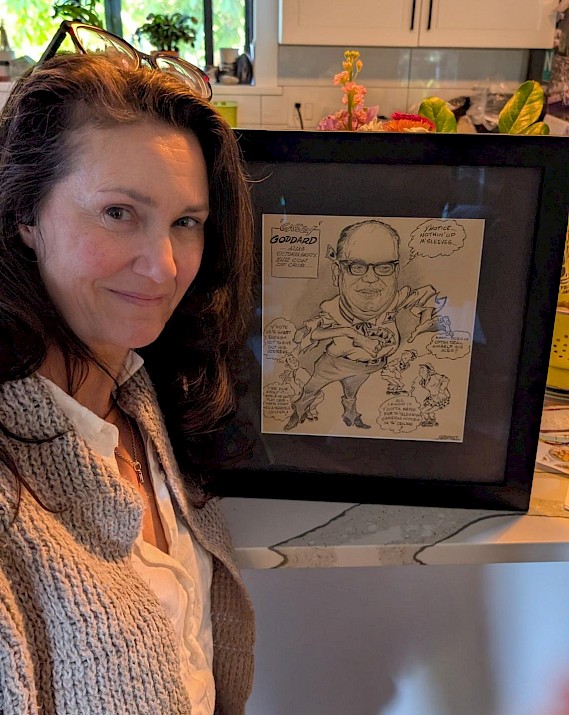
Kim shares a caricature of her father, Casey Goddard.
Kim reminisced about a time in her life when she was scouting for jobs in the film and television industry. After hearing about a local company working on a movie, her dad took the initiative to drive her downtown for a visit.
“We had to look up the address in the Yellow Pages. He drove me to the office and then encouraged me to go knock on the door and hand in my resume. I'd never done anything quite so nervy in my entire life,” Kim says. While she didn’t land the job, the visit led to an introduction to a production coordinator who would later become her lifelong mentor.
“I tell this story because one never knows where your path may lead, or what your network actually looks like, or if your dad forces you into the car on a Thursday afternoon to hand in a resume.”
BUILT ON COMMUNITY, CONNECTION, AND COLLABORATION
The Production Office is the hub for all things administrative and logistical. Producers, directors, and coordinators come together to ensure that a show runs smoothly. “We’re in the business of running the business,” Kim says. Managing contracts, onboarding employees, disseminating information, making travel arrangements, posting safety protocols, tracking license plates, and taking lunch orders make up just a small percentage of what goes on in the Production Office.
“The department is typically filled with really capable, personable, resourceful, and efficient people who have a great can-do attitude,” Kim says. Not only is there a vast amount of facilitation, there’s also a lot of hospitality that goes along with the work. Kim describes it as a service department. “There are all kinds of unusual requests that come our way. Things like hiring dog walkers and sending flowers to someone’s mother-in-law whose birthday it is,” she says.
In 2022, the Production Office Department Chair position was up for election. Unbeknownst to Kim, she was nominated by a young colleague who she'd hired onto a show in the past. While members can self-nominate or be nominated for elections, Kim recalls a conversation with her colleague, friend, current 891 Executive Board member, and then-department chair Eva Morgan. Having held that role for over 20 years, Eva told Kim that in all that time, Kim was the only person to be nominated by another member for the position. No other nominees emerged, and in November 2022, Kim was acclaimed as the new Production Office Chair.
“I’m filled with a new sense of gratitude,” Kim says, reflecting on her journey in the role. She describes going from having limited awareness of what the Union does for its members to now preparing agendas for her own departmental meetings, finding new ways to engage with members, and collaborating with the Training Department to launch a course tailored to the specific needs of her department.
“We’re doing our best to engage, inspire, and provide information to support our department with the knowledge that we have,” she says.
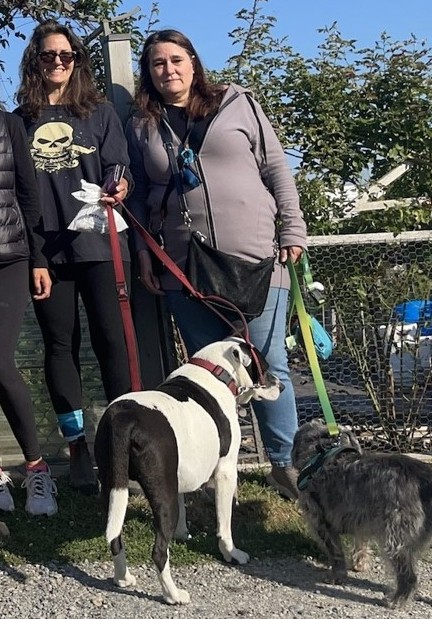
Kim and Eva Morgan while dog walking.
The importance of being part of a unionized community takes on many forms, Kim says, identifying the sense of community, connection to one another, and interdepartmental collaboration as some of her most valued aspects. She recognizes that the industry is not for the weak of heart and that it takes a certain amount of tenacity and resourcefulness.
“When you’re an 891 member, you’ve made it to the show. You have proven that you are capable, intelligent, that you are devoted to the film and television production industry,” she says. Kim is a huge advocate for collaboration and the sharing of information. During the Production Office department bootcamps, she often welcomes other department chairs to join and share their best practices and learnings.
“This is a technician's union, and you can really feel how important the craft is. While some might not describe facilitation as craft, I promise you it is. There's a lot that goes into the work that we do, and all of it has a craftsman like appeal,” she adds.
DAY IN THE LIFE AS A PRODUCTION OFFICE COORDINATOR ON SET
Though not every day looks the same in the ‘hive’, we asked Kim to walk us through a “typical” day in the life as Production Office Coordinator.
LET’S SET THE SCENE: IT’S DAY 32/87 OF FILMING
It’s around 7:00 am. The unit is parked at the studio on the stages. Phone in hand, the first thing Kim does when she arrives is boot up her computer and check for messages. As a Coordinator, her mornings can go in any direction. She might be supporting rigging crews with equipment, assisting with purchase orders, requesting quotes for equipment houses, or onboarding a new supplier. Much of her work also revolves around schedule changes and last-minute requests.
If a scene originally scheduled to be filmed on Friday is suddenly moved up to Wednesday, Kim and her team are on high alert – rebooking flights, adjusting hotel reservations and transportation, and coordinating with other departments to confirm crew availability. “One never knows,” Kim says. “I might step into that office on Monday morning expecting to do one set of tasks, and something completely different will take priority. Being tenacious and flexible is a very, very desired quality for anyone working in the production department.”
It is now 12:00 pm, and the team takes a 30-minute lunch break. All the while, their phones are glued to their hands, checking for messages, emails, and staying aware of everything happening around them. In the afternoon, the prelim1 is published, what Kim describes as “a little bit of a celebration about what’s happening tomorrow.” The team reviews it carefully, making sure everything is in place for the next day and flagging any changes.
“We are members of the orchestra, and everybody knows how to read the music, and that's what that prelim is,” Kim explains. “When that information comes to us, it is our priority to share that with everybody so that we're all on the same page.”
Later in the day, the focus shifts to the prep schedule2 – an integral part of their communication. This document contains all the meeting information, from Zoom links and location surveys to notices of unavailability, helping all departments stay aligned in the lead-up to filming.
The time is 6:00 pm. The crew is wrapping up its final, or second-to-last, scene of the day, and some departments have already headed home. Kim and her team are preparing for the publication of the call sheet3. Another key part of Kim’s role is working with assistant directors to ensure that the crew is fully informed of the day’s safety considerations. Whenever special effects, stunts, or equipment are involved, safety bulletins must be updated and clearly communicated.
Once the final paperwork is complete, the call sheet is sent out. “We start wrapping our crew, clean up the kitchen, check our emails one last time before we get in our cars and drive home, and do it all over again Tuesday, Wednesday, Thursday, Friday.”
1. Prelim: In a Production Office, a prelim (short for "preliminary call sheet") is an early draft version of the next day’s shooting schedule issued to the crew and cast. This is distributed by the Production Office.
2. Prep Schedule: A detailed, day-by-day blueprint that outlines all tasks required to prepare for filming, typically spanning from project greenlight to the first day of production.
3. Call Sheet: A daily document created by the 2nd Assistant Director, in collaboration with Production and all other Departments that outlines the schedule, locations, and logistical details for a cast and crew, usually sent the night before filming.
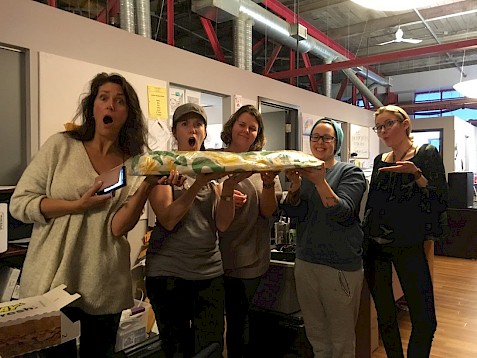
Kim and her team share a celebratory sandwich.
BEHIND THE SCENES: STORIES ON SET
A moment in Kim’s career that she will never forget is when she coordinated her first feature film – Summer of the Monkeys. She was hired as head of department, and having never done that before, she was filled with excitement, gratitude, and focus. “I just wanted to do the best I possibly could,” she says. “When I think back about my favourite projects, this is at the top of the chart. Not because of the content, or how big and magnificent it was, but because it was my start as a young coordinator.” While working on the film, Kim even got to meet a diaper-wearing chimpanzee named Louie!
“They sat him in my lap, and I got to breathe him in and feel his little hands. What other job do you get to meet a chimpanzee in a diaper?”
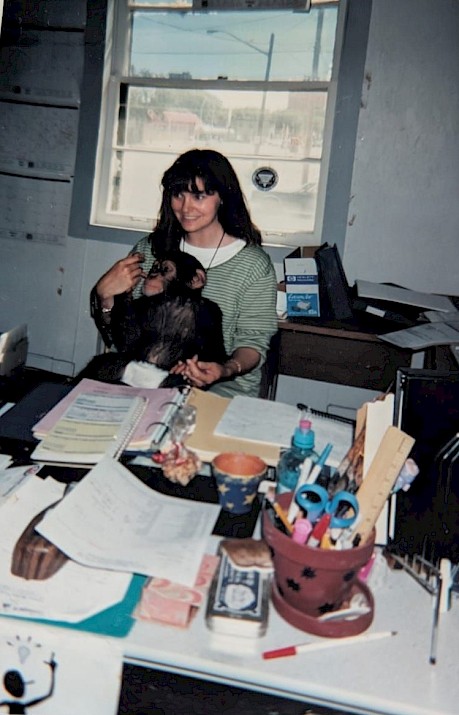
Kim and Louie the chimpanzee on the set of 'Summer of the Monkeys'
Kim describes coordinating production on Shōgun as an “extraordinary experience.” It was her first multi-language, multicultural production, and one early idea stood out: incorporating Kanji into crew lists, cast lists, and nameplates. Kanji is one of the main Japanese systems of writing that utilizes characters borrowed from Chinese writing. Kanji characters carry deep meaning and are chosen with great care, which meant that there was no room for error. Rather than relying on generators, two interpreters worked meticulously to create Kanji for hundreds of Canadian crew members while consulting with Japanese cast and crew.
“We would eventually create our production paperwork in both languages,” Kim says, “but this was one of the first applied ideas from Production that served to unify the Canadian and Japanese crew and cast. Administrative arts can be creative too.”
Legion Season One remains one of Kim’s favourite projects for many reasons. With Noah Hawley at the helm, the series featured a marvelous cast including Dan Stevens, Audrey Plaza, Jean Smart and Jemaine Clement, and scripts that constantly kept audiences guessing.
“I learned a lot about taxidermy, for shipping reasons, and about mental illness, to better understand the story. It was also the first show I had worked on that truly embraced sustainability as a shared responsibility across the entire production,” Kim says.
Members of all departments were encouraged to think creatively about reusing materials and reducing consumption. “I'm left remembering the team effort, the camaraderie, and the good humour of the cast and crew.”
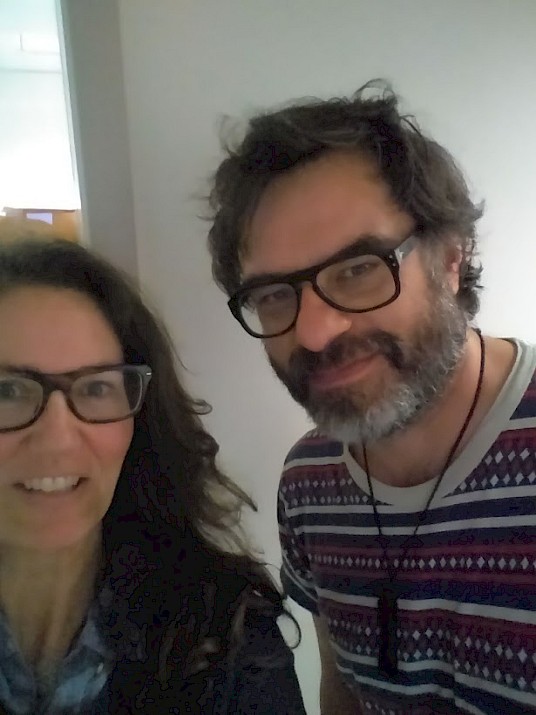
Kim and actor Jemaine Clement, who plays Oliver Bird in 'Legion Season One'.
Kim has worked on an array of award-winning, globally recognized films such as Inception, The Revenant, and Interstellar. Kim says that working on Inception gave her an immense amount of confidence to make the career move to Vancouver, BC.
“I had just always assumed that Vancouver production coordinators were a cut above, and I didn't put myself in the same category. But having worked on that film, it really gave me the confidence to say, I probably can do this. I can step into this larger arena and do myself proud.”
“MORE THAN JUST PAPER PUSHERS”
Kim’s favourite part of the job, if she had to pick one, is the sense of accomplishment in running a great crew. “For those who might think that the Production Office are just paper pushers, or purchase order writers… there’s so much more that goes into that.” Kim says. “They are clever, resourceful, hardworking, intelligent, hospitable people that sit in those chairs every day and do their best.”
For anyone that is looking to get their foot in the Production Office world, Kim’s advice is to ask yourself, “how hard can it be?” and put yourself out there. Send out your resumes, knock on doors, go to networking events, and ask lots of questions, because you never know what opportunity might be presented to you on any given day.
Written by Erica Lim, Copywriter for IATSE 891.
Are you an 891 member who’d like to be featured in a Spotlight? Know an 891 member making BC’s motion picture community a better place for all workers? Email Spotlight suggestions to communications@iatse.com. Read more 891 Member Spotlights here! Visit Ourwork.ca for more on the benefits of joining the Union.