MEMBER SPOTLIGHT: BRINGING IDEAS TO LIFE WITH CONCEPT DESIGNER KEITH LAU
Have you ever watched a film or television series and wondered who turns ideas into the characters and worlds that we all know and love? From mythical creatures and demigods to video game characters in post-apocalyptic worlds, concept designers are often the first to shape a story’s visual identity. In this Member Spotlight, we sit down with Keith Lau – concept designer, illustrator, and member of the Art, Costume, and Visual Effects departments at IATSE 891. With credits to his name such as ‘The Last of Us’, ‘Percy Jackson and the Olympians’, ‘Avatar: The Last Airbender’ and ‘A Series of Unfortunate Events', Keith shares the behind-the-scenes of his creative process, his journey in the motion picture industry, and why he’s proud to be part of the Canadian film and television community.
WHERE IT ALL BEGAN
Four-year-old Keith spent most of his time sketching Ninja Turtles, robots, and his favourite cartoon characters. His fascination with visual arts developed at an early age, and whether it was painting, hand sculpting, or simply doodling, creativity came naturally to him.
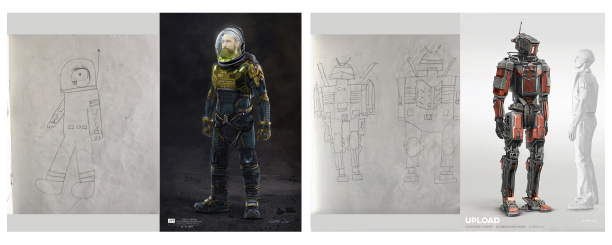
Side-by-side comparisons of Keith’s childhood drawings and recent designs.
Keith’s career began in 1998.
“What do you want to do when you finish school?” was the question that started it all. When his Grade 12 substitute teacher asked, Keith answered without hesitation: “I want to work in the movies.”
A classmate across the room chimed in, “Oh, I know someone!”
That “someone” was Bill Terezakis, the late Co-Owner of Evolution Arts, a makeup effects studio in Richmond, BC. A quick exchange of phone numbers led to an informal interview, and soon after, Keith was hired as an intern.
“The strangest part was that the studio was literally behind my house,” Keith recalls.
“I was a little hesitant to go in, and it sounds cheesy, but part of me knew if I walked through that door, things could change”
At Evolution Arts, Keith learned the fundamentals of mold-making, prosthetics, and sculpting. More importantly, the experience gave him the confidence and reassurance he needed to pursue art as a career.
“It was encouraging to see that the crew around me were able to make a living doing art.”
With the support of his mentors, Keith spent the next six years furthering his education, first in Langara College’s Fine Arts Program, then at Emily Carr University of Art and Design, where he majored in Industrial Design. He spent his summers taking on creative gigs and hands-on projects at Bill Terezakis’ new studio, W.C.T. Productions, and various studios such as Lindala Schminken FX, continuing to refine the skills that would shape his future career.
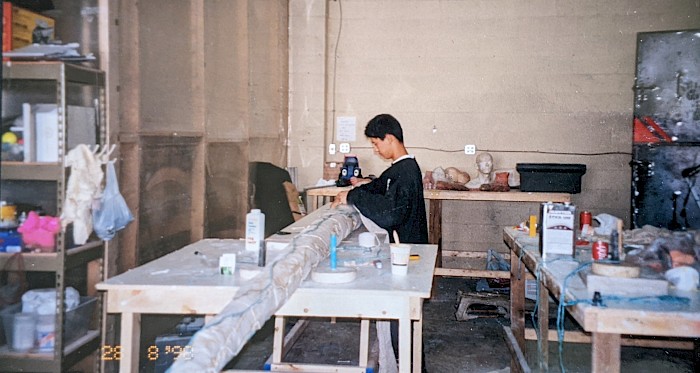
Keith working on his first film project at Evolution Arts in 1998.
Fast forward to August of 2011, Keith attended the SIGGRAPH (Special Interest Group on Computer Graphics and Interactive Techniques) conference. There, he came across the IATSE 891 booth and was introduced to Dusty Kelly, the Local’s Corresponding Secretary and Organizer at the time.
Thanks to his extensive experience and portfolio, Keith was accepted into the Union the following week. Shortly after, he landed his first role as a Graphic Designer and Concept Illustrator on 'Once Upon a Time'.
Keith gave a special shoutout to his identical twin brother, Howard Lau, who shared much of this early journey with him. They interned at Evolution Arts alongside one another, joined the Union together, and supported each other through the formative years of their careers. Howard is an Illustrator, Concept Designer, and a member of the Art and Visual Effects Departments at IATSE 891.
CONCEPT DESIGNING: BRINGING IDEAS TO LIFE
In film and television, Concept Designers (or Concept Artists) take early ideas from directors and production designers and translate them into visual artwork. This can include environments, props, costumes, characters, or even CG creatures.
“You’re being fed ideas, images, locations, and sets, and you’re responsible for putting all the pieces together.”
As a Concept Designer, Keith shapes the visual identity of the world before it’s built, filmed, or animated.
In this Member Spotlight, we asked Keith about his experience working on ‘The Last of Us’, ‘Avatar: The Last Airbender’, and ‘Percy Jackson and the Olympians’ – three of the largest, most prominent television series filmed in British Columbia.
Read along to discover Keith’s creative process, his approach to adapting beloved video games and animated classics, and the lessons he’s learned from his years in the industry. *This interview has been edited for clarity.
'THE LAST OF US'
How do you balance honouring the original artwork while also incorporating your own creative ideas and artistic perspective?
It's tricky. I try to maintain the essence of the video game characters when translating them to live action, while also following the vision of the Production and Costume Designer. If I can, I’ll add some personal touches to a character’s facial expressions, stance, make-up, hair, or even their environment to bring something new and fresh.
Production faced some backlash over the casting, and there were high expectations to meet. In this industry, you come to accept that people will always have their opinions.
My job is to create art that convinces the audience that this version of the character belongs in this world and hopefully everyone gets it.
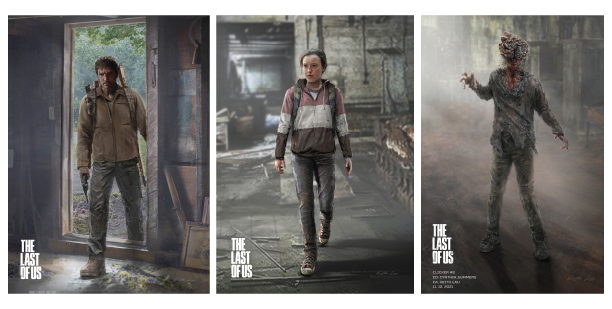
Keith’s concept illustrations (Joel Miller, Ellie Williams, and Clicker) for ‘The Last of Us – Season 1’ Costume Designer Cynthia Summers.
What was it like creating the concept design for Pedro Pascal’s character, Joel Miller?
Translating Joel from the game was challenging because Pedro Pascal doesn't closely resemble Joel, so I tried to add touches of grit and darker tones to each of his illustrations to better capture the character's personality.
I also tried to include backgrounds that would reflect the story arc and tie everything together. I was happy to find out that the neighbourhood they ended up filming in was very similar to the background I had chosen and imagined.
Did you also play the video game as part of your research?
No… I’m not good at keeping up with pop culture. I don’t play video games and rarely watch TV.
In a way though, it’s like a blessing in disguise. I don’t get attached to a project, nor do I get intimidated. However, for The Last of Us, there was some added pressure because I know how big [the video game] was.
'AVATAR: THE LAST AIRBENDER'
Do you have a favourite concept piece you did for this series?
I don’t necessarily have a favourite. It’s always hard to choose, but I can definitely say that I’m pleased with it overall. I’d rather be happy with the project as a whole than get attached to one individual piece.
In a similar sense, I try not to get too attached to my concept drawings. If the director or studio decides to go in a different direction, there's no point in being disappointed. You have to emotionally separate yourself from your work and understand that it is part of the process.
A project never goes smoothly, and everything can change, but we enjoy the process along the way.
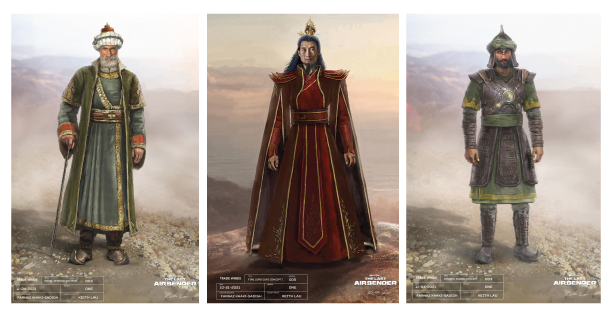
Keith’s concept illustrations (Omashu Royal Advisor, Fire Lord Ozai, and Earth Kingdom Guard) for ‘Avatar: The Last Airbender – Season 1’ Costume Designer, Farnaz Khaki-Sadigh.
Does that come with experience, or were you always very practical and logical?
Definitely through experience. You learn to do things differently, sometimes faster, and you grow a lot from working with different people as well.
'Avatar: The Last Airbender' is aesthetically influenced by many real-world cultures, particularly East Asian cultures. How much research goes into developing concepts for a project like this?
For me, I was very keen on including Asian characters in my drawings to represent the different nations. I wanted to stay truthful to the world that Avatar is meant to be.
For example, I was told that the Earth Kingdom is more influenced by South Asian culture, whereas the Fire Nation is more East-Asian oriented. I try my best to honour that.
'PERCY JACKSON AND THE OLYMPIANS'
Congratulations on being nominated Excellence in Crafts – Costume Illustration at this year’s CAFTCAD Awards! What was it like designing for a series that features such mythical and larger-than-life characters?
Thank you. The Percy Jackson series was a very exciting project because it brought together everything I’ve worked on throughout my career. I had previously worked on 'Percy Jackson: Sea of Monsters', and I also did a few seasons of 'Once Upon a Time', which lives in a similar fantasy space with medieval and creature-like elements.
The Percy Jackson universe is so iconic and has a very dedicated, existing fanbase. Did that bring any added pressure for you going into the project?
Oh, yeah. I feel very lucky to be given the opportunity to work on shows that are bigger in notoriety, but I do feel the pressure.
With 'Percy Jackson: Sea of Monsters', a lot of fans were complaining that it didn’t feel truthful to the books. Even my son and his classmates who watched the movie told me, “It’s not the same,” so the pressure was definitely there.
So, when I started working on the first season of 'Percy Jackson and the Olympians', I wanted to make sure we capture the essence of the book more. The Costume Designer, Tish Monaghan, her team, and I were all on the same page.
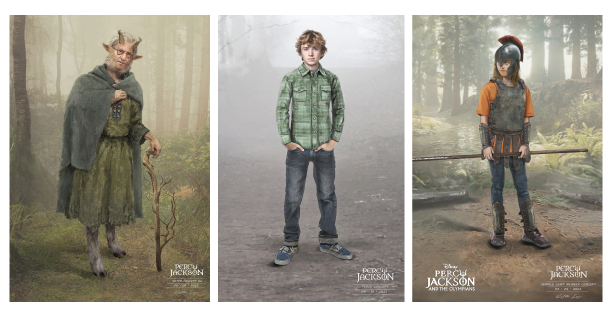
Keith’s concept illustrations (Satyr, Percy Jackson, and a female camp member) for ‘Percy Jackson and the Olympians – Season 1’ Costume Designer Tish Monaghan.
How do you balance creativity with the realities of what can actually be built and worn on set?
I come from a practical effects background, so when I’m coming up with concept designs, I always try to think like a builder first. I try to ask questions like: How much time do we have? What material is it? Are the stunt performers wearing it?
You can create a great drawing, but if it can’t actually be built, it doesn't help anyone. It can also set production back in both time and budget.
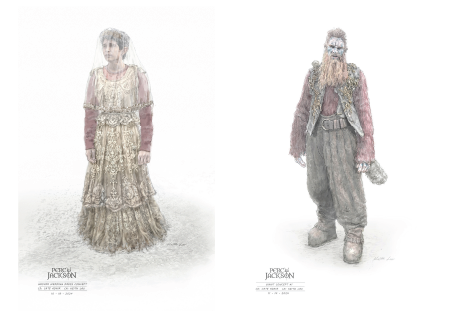
Keith’s illustrations for ‘Percy Jackson and the Olympians – Season 2’ Costume Designer Cate Adair, which were nominated for “Excellence in Crafts – Costume Illustrations” at the 2026 CAFTCAD Awards.
THE COMMUNITY THAT MAKES CANADIAN FILM SPECIAL
With over 26 years of industry experience under his belt, Keith says it’s the people that inspires him to keep going.
“Film people are very passionate… The amount of dedication it takes to work in film is something that most people probably wouldn’t understand.”
The motion picture industry is constantly evolving, changing, and it is no ordinary 9 to 5. Sometimes you sacrifice a paycheck, you take a risk, you follow your gut even when it might not make sense to others. But that’s the nature of the work.
“I can’t imagine myself doing anything else,” says Keith. “I do it for my family, but I also do it for the people I meet. We’re all going through a journey, but it’s the togetherness that makes it special.”
Among the many productions he’s worked on, The Last of Us stands out to Keith not just for the project itself, but for the Canadian motion picture community as a whole.
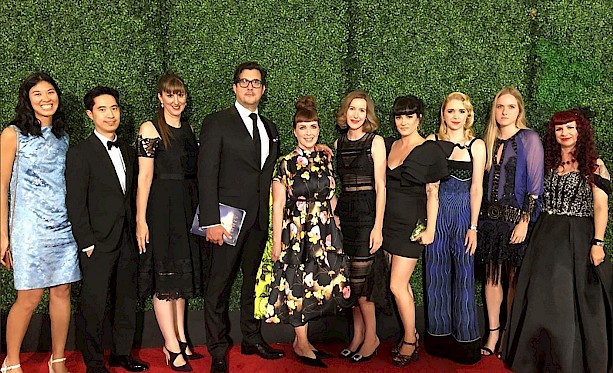
Keith (second left) with Costume Designer Cynthia Summers (middle) and the rest of the ‘A Series of Unfortunate Events – Season 2’ costume team at the Emmy Awards in 2018.
“It was one of the projects where the world took notice,” he says. “It was an accomplishment for the people of Alberta (where Season 1 was shot), the Vancouver crew, and I was very proud of how everyone showed their talent. Having the world recognize that was gratifying.”
Keith says that everyone on the production felt the weight of the project. There was a shared determination to prove that the creators didn’t choose Canada by accident – they chose it for the talent, the skills, and the artistry of our crew.
When Keith looks at the Vancouver film and television community today, he feels an immense sense of pride.
“I’m proud that the world sees us an equal.”
“Hollywood has this great reputation, and as Canadians, we all want to be respected in that realm. I’m proud to say that we’ve really shown the world what we can do.”
Check out more of Keith’s work here!
Written by Erica Lim, Copywriter for IATSE 891.
Are you an 891 member who’d like to be featured in a Spotlight? Know an 891 member making BC’s motion picture community a better place for all workers? Email Spotlight suggestions to communications@iatse.com. Read more 891 Member Spotlights here! Visit Ourwork.ca for more on the benefits of joining the Union.