MEMBER SPOTLIGHT Q&A: TAIZE POWELL
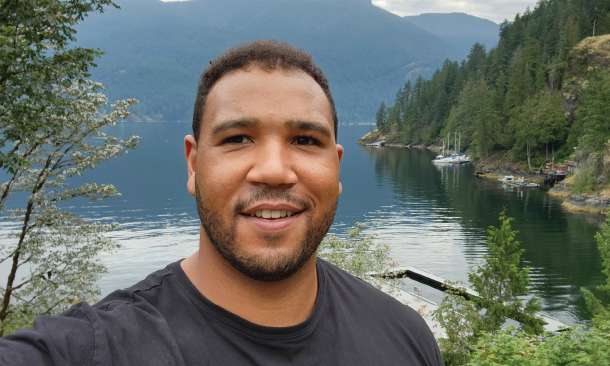
Taize Powell’s backyard and playground growing up was BC’s burgeoning film industry. The 891 Paint Department member lived next door to what would grow to become Burnaby’s massive Mammoth Studios, and he spent many days of his youth exploring a large props warehouse that stored a treasure trove of set pieces used on some of the biggest productions in North America. Starting out as a scenic painter, Taize is now in charge of crews as a Paint Coordinator. In this Spotlight Q&A, he shares more about the illusionary magic the Paint Department can create for film, his career journey in motion picture production, why he’s excited about the growth of the industry on Vancouver Island, and the importance of the film industry honouring Black History and Futures Month by telling more stories of people of colour making motion picture magic in BC.
WHAT INFLUENCES LED YOU INTO MOTION PICTURE PRODUCTION AS A CAREER?
I always saw myself working in the motion picture industry. I thought maybe I’d get into acting at first, but film was always something I wanted to get into, and it just was a matter of how and where. It was always an early life inspiration for sure. I grew up right behind Mammoth Studios, so I remember when Mammoth Studios was just at Bay Warehouse. Then, it got transferred over and now it's one of the biggest studios around.
I was around the influence of the film industry all the time. Between the ages of eight to 12, I would spend a lot of time inside this huge props house called CanAm. They were like a liquidator for film and had everything you could think of and things you wouldn’t have even imagined. As a young kid, my mom would drop me off in there sometimes and I would just wander around the place for hours, just looking at the different set pieces and props. They had different pieces of movie sets that were quite famous. I remember they had a giant pharaoh head from the Ten Commandments. They had all kinds of different interesting pieces. It's sad that it's gone now, but it was a huge influence for sure. Wandering around that place allowed me to see the film industry from the inside out, and maybe that's one of the reasons why I got involved behind the scenes as opposed to in front of the camera.
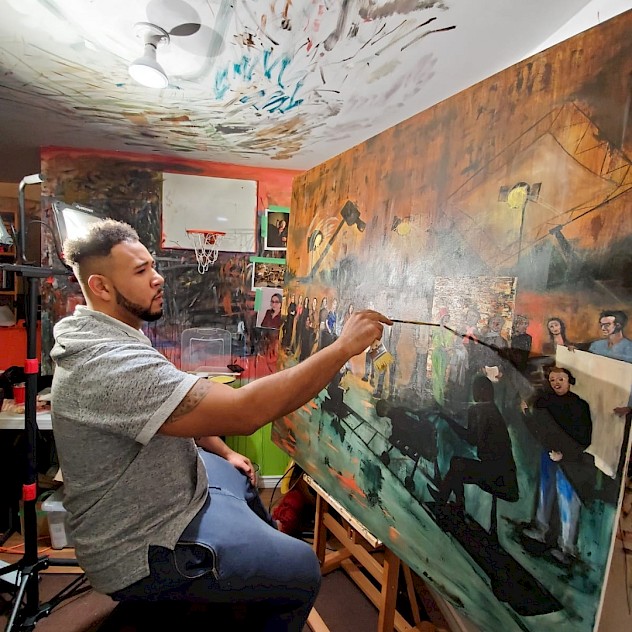
Beyond where I grew up, I've always been a creative person, and my mother is a very creative person as well. She worked as a florist and did some interior design. I was always heavily influenced artistically by her and did a lot of art as a young age. She used to teach calligraphy, so I just spent a lot of time around creative activities.
In the neighbourhood that I grew up in Burnaby, there's a famous actor named Dee Jay Jackson that lived close by and I was always hanging out around him when I was growing up and so that was another big influence on me. He acted in Happy Gilmore and a lot of different roles.
In high school, I was part of a lot of art programmes, but I went into the sports direction and wanted to be a professional football player. But life sometimes turns you in a different direction, and film was always something I wanted to get involved with, but it just took until my early 20s to pursue it. We lived next door to a man that ended up becoming a dear friend of mine and he was a famous scenic artist. We spent a lot of time together, he was doing sculpting, and I got to know him quite well. He helped me find my way into the film industry. His name was Colin Comeau, and he was a huge influence on my early career. I started by doing a little bit of rigging and then with his support, I got into the Paint Department and started helping him out and made my way up from the bottom.
WHAT DO YOU LOVE MOST ABOUT SCENIC PAINTING FOR THE FILM INDUSTRY?
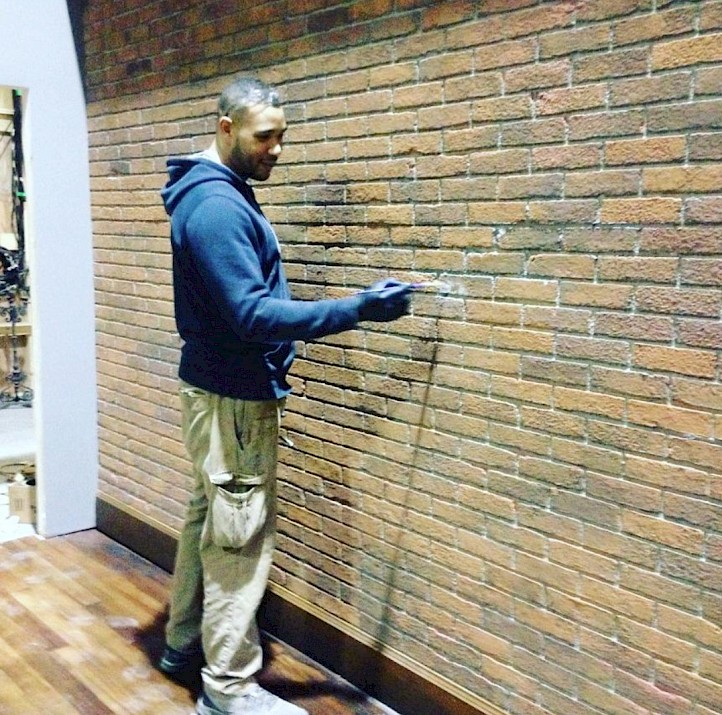
We're kind of like the finishers in the sense that we put the finishing look on the movie sets. Construction will build a set and then we're the ones that give it the final look. If something needs to be rusty and old, we’ll make it look rusty and old. If it needs to look like it's peeling paint, like there's layers of history there, then we add all those layers. We do a lot of distressing, and we make rocks or brick balls or stone walls. But sometimes we’re doing fine art painting like oil paintings you might have for backdrops.
There are many different elements to the world of being a scenic artist. One of the things that makes it so cool is that you get to cover so many different sides of the arts. The other day I was doing calligraphy for some envelopes. Sometimes it could be doing Venetian plaster. We do all kinds of plaster finishes. There’s a lot of different elements to it. We paint different kinds of backdrops and sometimes they'll have to be painted in different methods to marry with the camera in a certain way. It's cool because there's always a challenge, especially dealing with locations and dealing with different environments you’re in.
CAN YOU SHARE SOME MEMORABLE ANECDOTES ABOUT THE CHALLENGES & JOY OF YOUR WORK IN BC’S MOTION PICTURE INDUSTRY?
Because so much of what we do is in the natural environment, it's important that what we're doing is environmentally friendly. There was one time I had a vehicle that I needed to age, which basically meant covering it completely with something to make it look old and dirty. Because it was going to be out in the forest, it had to be staged with something environmentally friendly. I ended up using a bunch of different spices like poultry spice and cinnamon and paprika and different things that weren't going to be too bad for the environment. It’s always a challenge and an experiment to try to figure out what's going to work and what isn't going to work. Some of the tricks are known, but the poultry spice was my own specialty you could say. It was the right colour that I needed.
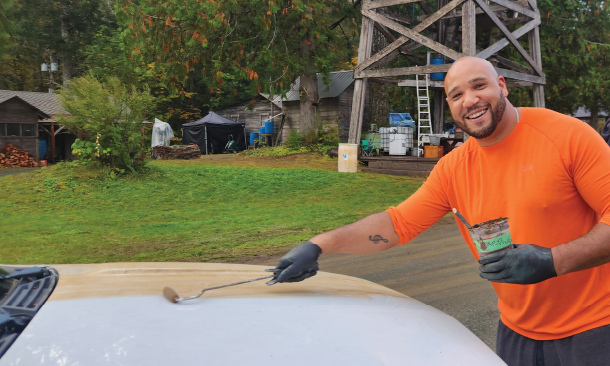
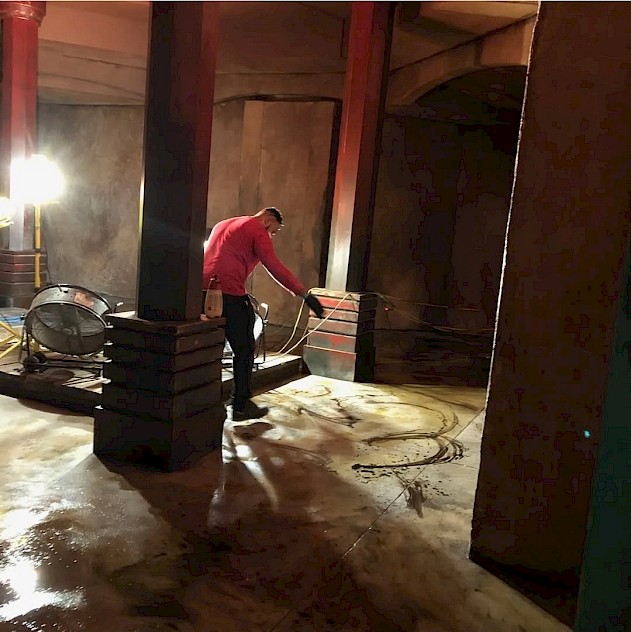
Taize marinating a car in the forest with poultry spice and cinnamon to make it look aged for a production – just one of many examples of the creative problem solving required of scenic artists working in the film industry to build the right look while having a minimal impact on the environment and locations they are working in.
For another anecdote, there was a time I had to cover up a bunch of different logos on some excavating equipment up in Squamish. I was in a lumber yard and it's pretty trying conditions. The wind was blowing very heavily, and it all just descended into disaster. Everything just blew away. I had my table set up on top of my truck and it blew away everything. The lumber yard was covered in vinyl pieces, and it was an example of things not working out so well. But these are the different conditions that we're up against.
Another time working up on Grouse Mountain, I was putting vinyl over a big oil tank and it was at the top of the mountain, and the wind’s blowing, and it's snowing, and I ended up having to use Vaseline to cover up the logo to make the vinyl stick properly, but I ended up using probably a whole bucket of Vaseline to make the vinyl stick in the snow and in the ice. But it's just part of the challenge, and that's something that I always love is the various challenges working in different locations, like the Squamish River or abandoned buildings, or unique environments.
WHAT ARE SOME OF YOUR FAVOURITE PRODUCTIONS YOU’VE WORKED ON?
I did some really cool features in the beginning of my career. I worked on the Big Friendly Giant and that was pretty awesome. It was really an amazing movie to work on. All the sets were very scenic. We recreated a big portion of Old London basically through Mammoth Studios and a lot of the sets were done to scale because the whole show was about these big giants, so there were different pieces that we would have to scale for a big giant like these giant trees that we did. It was so cool, especially because it was pretty early on in my career.
Since then, one of my favourites that I've worked on I would say is the TV show Virgin River. I was part of about four seasons of Virgin River, and it was one of the best shows that I've ever worked on. It had unique locations and so much hand painted work and hand painted floors, and in terms of scenic art, doing unique ageing and detailed work. It was a really fun opportunity. A lot of times as opposed to hand painting all the floors, you would lay a floor and then we might age it or make it look the way it needs to. In this case, everything was just hand painted so we would paint the designs right onto the floor by hand, which was just artistically a really special and fun thing to be able to do with all the sets. It was a great memory that I'll hold for the rest of my career.
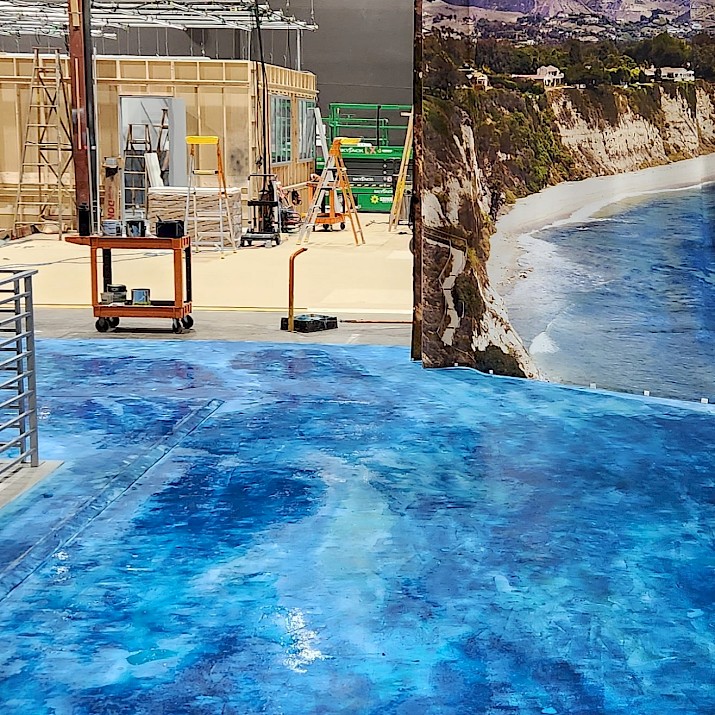
Taize’s work as a scenic artist for the motion picture industry involves painting on all kinds of surfaces to create illusions and effects that elevate how things look on camera.
WHAT ARE YOU EXCITED ABOUT NEXT WHEN IT COMES TO WORK IN BC’S MOTION PICTURE INDUSTRY?
Now I'm coordinating and I’ve been able to build some new awesome relationships and having some fun and amazing experiences in a new kind of role. Vancouver Island is where I'm really focusing my career at the moment and that's where I'm based. It's where my family is and I think there's a huge opportunity for the film industry to grow over here.
I just finished coordinating Easton Prep – a series that's coming out on Netflix which has been an amazing experience with really awesome relationships that I've been able to build and some of the cool unique sets that we've done and locations that we've been able to work at. It's something I'm personally really excited about. I think there's a lot of potential for growth. One of the biggest parts of what we offer in BC as a province is our locations, right? We have such unique and amazing locations to shoot at and then coupled with our amazing crews and all the talent that's here, it's really an awesome thing that we're able to deliver what we do. When you look at Vancouver Island in terms of locations, I personally believe this is the jewel in the crown as it were. You have such a beautiful landscape in so many different, diverse settings, and now it's just a matter of supporting the industry base that’s here, having more crews, and further supporting the talented and capable people here. We just need to keep growing that base and I see it happening, which is exciting.
I've coordinated probably three smaller shows over the last five or six years. Easton Prep is the first and biggest IATSE show that I’ve coordinated. In terms of transitioning, it's been good. I've enjoyed it. It's high pressure but I hope that I'm able to set an example for other people that can see my career and what I’m doing now and think that hey, in the future this is possible. I've paid my dues and worked towards it over the years. It's been very satisfying and I've been blessed to be in a situation where I was given a lot of creative freedom. It’s been an exciting transition to get into coordinating.
WHAT DO YOU VALUE MOST ABOUT BEING A MEMBER OF A UNIONIZED FILM COMMUNITY?
Being a union member provides a layer of community, but also a layer of solidarity. You're part of a family and part of a team. We have ideas that we all hold strong as a team. It's awesome to be part of something where you can be associated with a lot of different like-minded and creative people. We have a high standard for what we deliver. We are all here with the main focus of delivering high quality film work. That's what we do. Those standards are important and I think it's important we maintain those standards and that everybody takes that seriously and recognises that is something that sets us apart.
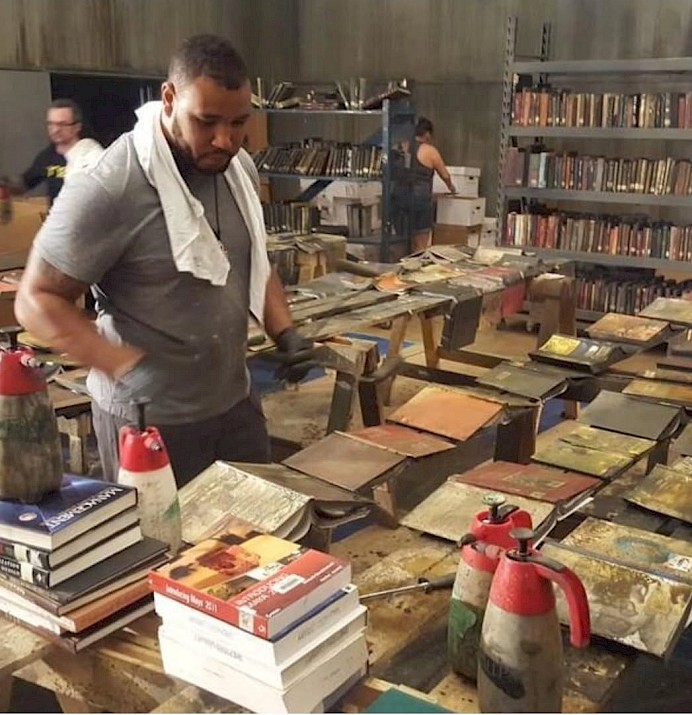
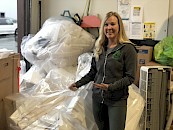
Taize ageing books for a production using various painting techniques.
Our work in motion picture production really does take resilience but that's one of the great things about IATSE is that there are so many people with you who are walking that path of being dedicated to creating high-quality film work, and so you're around like minded resilient, creative, amazing people. It's great.
HOW WOULD YOU LIKE TO SEE BC’S FILM COMMUNITY HONOUR BLACK HISTORY AND FUTURES MONTH THIS FEBRUARY?
It’s been heartwarming to see, in the last five years, there's been a strong focus on encouraging diversity and more equitable and inclusive environments for everybody. But I think that historically there's also been a lot of different Black film workers, whether it be technicians behind the scenes or actors, such as actors like my friend Dee Jay Jackson, or technicians like myself, people who for many years have done amazing work, and those people are out there and they deserve to be recognised. There are so many Black film workers doing amazing work and sometimes in trying environments and circumstances. Those people are out there, and they deserve to be acknowledged to have their stories told.
There's been a long history of amazingly talented people of colour and Black people working in different areas in the film industry, from acting, to even producing and directing to all the way down to behind the scenes. Those people are out there and have amazing stories and experiences and contributions and that ought to be recognised.
Here in BC, there are talented Black film workers like my friend Chad Bellamy who is really prolific in stunts. Everyone in 891 is familiar with Sheryl Wilson, who is a good friend and amazing at what she does. And my friend Ron Robinson is a truly talented carpenter. There may not be many of us, but we're there for sure.
WHAT IS ONE CHANGE YOU WANT TO SEE FOR THE FUTURE OF THE INDUSTRY?
I strongly believe that the more diversity you bring to a picture, the more depth you get out of the picture, the more layers, the more creative eyes, the more experiences that you have involved in a project, all make it better. I've seen it with my own eyes. I've seen how you get different styles, different ideas, different cultures bringing different things to the picture that help it become better.
When you look towards heads of departments, and people in positions of above the line positions, there's still a major lack of diversity in those fields. I would say that makes a difference. I do think it makes a difference. It can make a difference having diversity in the fields that have hiring power. We could do better trying to bring more diversity into those positions, but doing that is tough. It's a tough conversation. Unfortunately, you get hard push back pretty fast when you look at any methods to address that. For me, I have so many amazing people that I've worked with over my career. Amazing, amazing white people who've been supportive and people I love and so when I talk about these things, I never want to take light away from those amazing people. I think for the most part, that's what our union is made up of – really good, amazing people. But nonetheless, I think when we talk about diversity, if that's something we want, then there's room to grow, especially in know management style positions.
WHAT ADVICE DO YOU HAVE FOR PEOPLE WANTING TO WORK IN MOTION PICTURE PRODUCTION?
I would give two different pieces of advice. I'd say for people who are just trying to get going in film to be as dynamic as possible. Broadening your skill set and be able to adapt. A lot is changing. We’re now dealing with issues around AI, so a method that you might have learned in film school might now be completely gone. Be fluid and have crossover skills to have a career in film.
As for ambitions of becoming a Head of Department – it's very competitive and I think you have to have thick skin and be open to criticism constantly, and not be the type of person that's going to be easily moved off your square due to criticism because you're going to be under constant scrutiny and criticism from a myriad of people. It's important to keep a long focus. Find your big picture. For me, I wanted to be a Head of Department. I have bigger aspirations beyond that as well, and so that's what I try to stay focused on instead of the moment.
There are so many situations in film where something can go right or wrong and it can be completely out of your hands. Somebody can make a decision in a different department that can change everything you're doing, and at the end of the day, there's absolutely nothing you can do about it. If you lose focus in those moments, it's challenging. It's important to stay detached from the immediate outcome and stay focused on the big picture. It can be hard to do that for sure, but it’s important. I'm a perfectionist, and as a creative person, it's easy to get attached to what I'm doing creatively. But it’s about the big picture. It's about focusing on what this will look like at the end of the season.
It’s also important to still value your own opinion. As a creative person, you can't lose touch with who you are, creatively speaking. I always value my opinion over everybody else's because at the end of the day, I know what I'm doing. Really believing in your abilities and who you are is important because with that much criticism and scrutiny, you have to know when you did a good job. Someone else might have a different opinion but hold true to who you are because it is easy to lose yourself because you're constantly under the whim of others’ opinions. You can’t lose your creative confidence, because that's what makes you, you. Having that confidence is important. Nothing is forever in film, right? Every show, every job you have, for the most part is temporary. Long after one show is over, you still have to keep true to yourself.
Written by Claudia Goodine, Copywriter for IATSE 891.
Are you an 891 member who’d like to be featured in a Spotlight? Know an 891 member making BC’s motion picture community a better place for all workers? Email Spotlight suggestions to communications@iatse.com. Read more 891 Member Spotlights here! Visit Ourwork.ca for more on the benefits of joining the Union.